Everyone is watching the wrong fight. The coffee war that gets written about is Luckin versus Starbucks or Luckin versus Cotti- this is a Chinese story about who opens stores faster and discounts harder.
The real fight is this.
The second largest coffee operation on the planet is sitting inside a burger chain, and almost no one sees it under 'coffee'. As Starbucks closed its fiscal year in late September 2025 with 40,990 stores. Luckin had just over 33,000 almost all in China.
McCafe? 45,699.
McCafe is not actually #2 by revenue - as a coffee business it sits well behind Starbucks, which did $37.2 billion in total revenue last year. Third party industry estimates McDonald's system-wide coffee sales at around $3 billion. But Revenue ins't what matters here.
What McCafe owns is distribution. It has the largest physical coffee network in the world and the smallest brand identity relative to that network. It runs that network out of a small box: a McCafe counter or a compact format occupies a fraction of the floor space of a dedicated coffeehouse and it's all because it’s attached to McDonald's.
It doesn't have to build 40,000 stores, they already built it.
In 2023 McDonald’s opened CosMc's, a standalone beverage spinoff with churro cold brews and a galaxy-themed latte menu. Five locations. By mid-2025 all five were closed. The headlines called it a flop. The headlines missed it. CosMc's was never meant to scale as a chain. It was a live test environment, a way to learn which drinks moved, at what price, in what day and time. All without risking the core brand.
Once McDonald's had it's data, it shut the labs and moved the winners into McCafe, ran them through a 500-store test across Wisconsin and Colorado, and confirmed the test was highly successful and exceeded expectations. This national rollout launched on May 6, 2026.
As CosMc’s most likely came from watching Starbucks. Starbucks cold drinks now make up roughly 75% of Starbucks US sales. McDonald's watched that and most likely figured; the money in coffee is moving to cold, customisable, high-margin drinks, and those drinks travel well through a drive-thru.
McDonald's calls a beverage “more than $100 billion global opportunity”. That may seem like an exaggeration but it's not. It’s describing a category it intends to take part in and it will.
That's a threat nobody has seemed to witness.
Luckin's edge is price and density in one country. Starbucks' edge is brand and the social construct of what holding their cup means.
McCafe's edge is that it needs neither. It needs convenience and a customer already there, and it has both at a scale neither competitor can match.
McCafe does not have to win on craft. It has to win on the fact that you were going to McDonald's anyways...
The coffee war everyone is covering is a fight over who finishes second to Starbucks in China. The company actually positioned to finish second to Starbucks globally has 45,699 locations and just spent two years building a new beverage menu.
So, No. 2 is already in your neighbourhood. It's just wearing a different sign.
Sources cited at the bottom of the page.
Now for my Finance Readers:
The question for the next four quarters is whether distribution converts.
A bigger network only matters if people buy the drinks, and McDonald's has been fighting a traffic slowdown serious enough that it launched an under-$3 value menu in the same window.
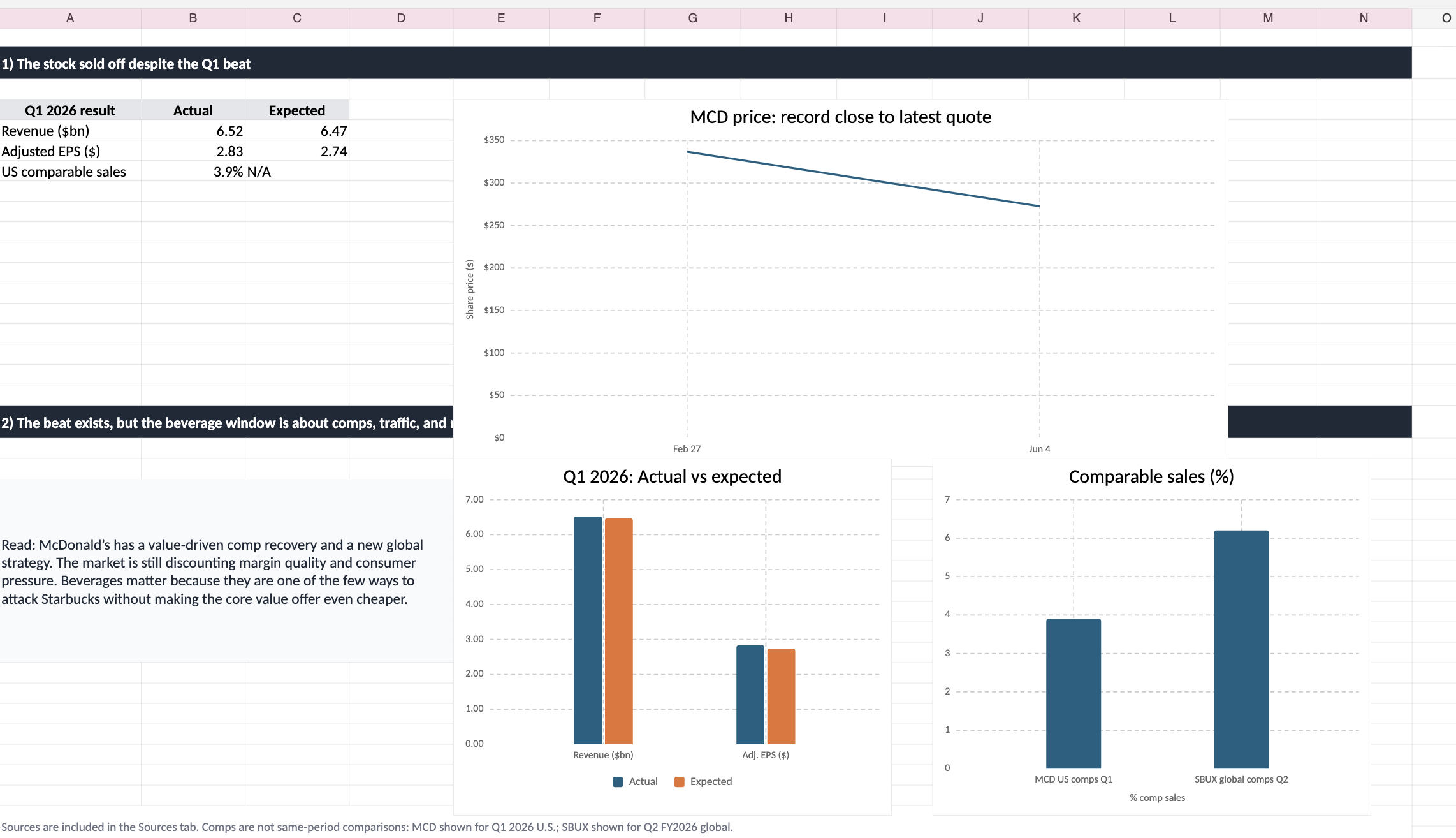
The market is already wrestling with it. $MCD set a record closing high of $336.88 on February 27, 2026, then gave back close to 19% into the $270s.
That's the interesting part.
The company beat Q1 2026 on both lines, revenue of $6.52B against $6.47B expected, adjusted EPS of $2.83 against $2.74. US comparable sales came in at +3.9%, a genuine swing off a negative year-ago base, driven by the value-menu pivot toward lower and middle income customers rather than by foot traffic.
So why drift down? Because the beat was bought, not earned at the counter.
Management flagged a Q2 slowdown, gas prices are rising, and the consumer McDonald's leaned on to deliver that 3.9% is the same consumer getting squeezed the hardest. Value protects comps and compresses margins in the same motion.
The CFO already called the US company-operated restaurant margins unacceptable.
Then on June 1, McDonald's unveiled "McDonald's > NEXT," its first new global strategy since Accelerating the Arches in 2020, built on menu quality, hospitality, restaurant productivity, and consumer connection.
The market has barely moved.
Meanwhile Starbucks just posted its turnaround quarter, $9.5B in revenue with comps up 6.2%. And McCafe's new lineup, fruit refreshers and a Red Bull collaboration, is landing at roughly half Starbucks' price.
Beverages are the one place McDonald's can attack a recovering Starbucks without touching the value-menu margin problem.
Watch August. This will tell us whether the widest coffee network on earth can finally turn reach into revenue.
Sources:
Store counts and revenue: McDonald's Q1 2026 results (45,699 locations as of March 31, 2026); Starbucks Q4 FY2025 (40,990 stores, $37.2B revenue) and Q2 FY2026 ($9.5B, comps +6.2%); Luckin Coffee Q1 2026 earnings (~33,000 stores). Beverage strategy: Restaurant Dive and QSR Magazine on the CosMc's pilot, the 500-store Wisconsin and Colorado test, and the May 6, 2026 McCafe rollout; Starbucks Q3 FY2023 commentary on cold drinks at 75% of US sales; McDonald's $100B beverage opportunity per company statements. Markets: McDonald's Q1 2026 beat (revenue $6.52B vs $6.47B expected, adjusted EPS $2.83 vs $2.74, US comps +3.9%) and CFO margin commentary, via the earnings release and CNBC; "McDonald's > NEXT" launch (June 1, 2026) via CNBC and QSR Magazine; MCD record closing high of $336.88 on Feb 27, 2026 and current price via Macrotrends. Note: McCafe is not broken out in McDonald's filings. The ~$3B figure is a third-party industry estimate.